

.jpg)

Road numbers are something most of us take for granted. Whether you’re cruising the A30 down in Cornwall or motoring along the M60 around Manchester, those familiar letters and digits quietly guide millions of journeys every year.
But have you ever wondered how these roads are named? Far from being random, Britain’s road network is organised by a system that’s been in place for over a century.
How A-roads and B-roads got their numbers
Long before motorways existed, the UK first introduced a road numbering system back in the 1920s. Roads were divided into A-roads (major routes) and B-roads (minor routes), and a zonal system was created to keep things organised.
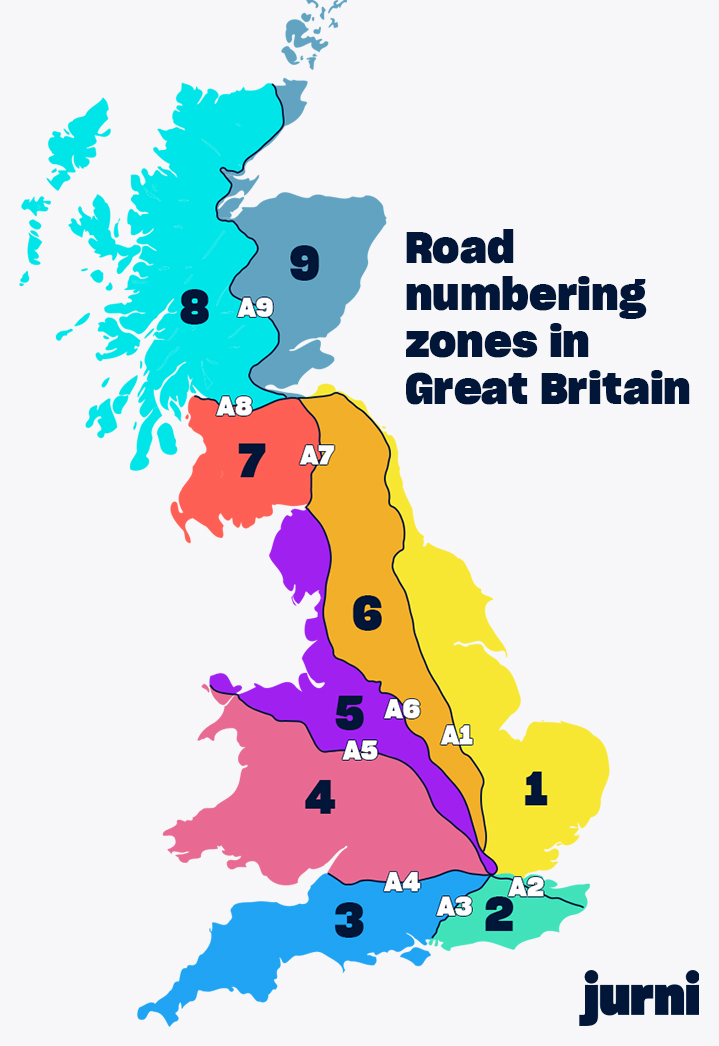
In England and Wales, six key A-roads radiate out from London like spokes on a wheel:
- A1 – London to Edinburgh
- A2 – London to Dover
- A3 – London to Portsmouth
- A4 – London to Bristol
- A5 – London to Holyhead
- A6 – London to Carlisle
These roads form the boundaries of six zones, numbered clockwise. The only exception is the A2, where the River Thames separates Zones 1 and 2.
In Scotland, the same zonal principle applies, but the hub is Edinburgh. Three key A-roads radiate outward to form the Scottish zones:
- A7 – Edinburgh to Carlisle
- A8 – Edinburgh to Greenock
- A9 – Falkirk to Scrabster
Any A-road or B-road starting in a particular zone begins with that zone’s digit. For example, the A41 begins in Zone 4, while the A52 starts in Zone 5.
When a road crosses several zones, its number comes from the furthest anticlockwise zone it enters. For example, the A38, which runs from Bodmin to Mansfield, starts in Zone 3 but passes through Zones 4, 5, and 6.
Originally, road numbers were designed to reflect importance. The most significant routes were given the shortest numbers: single-digit A-roads like the A1 through to the A9. Next came two-digit A-roads, followed by three- and four-digit routes for smaller, local roads. B-roads were only ever given three or four digits.
Over time, though, this hierarchy has blurred with the introduction of new motorways. Some short numbers still mark major routes, like the A66, while others, such as the A32, now carry far less importance.
How motorways got their numbers
When the first motorways opened in the late 1950s, starting with the Preston Bypass (now part of the M6), they couldn’t simply reuse A-road numbers. Instead, they were given their own “M” prefix.
Motorway numbering loosely follows the A-road zonal system but has a slightly different structure.
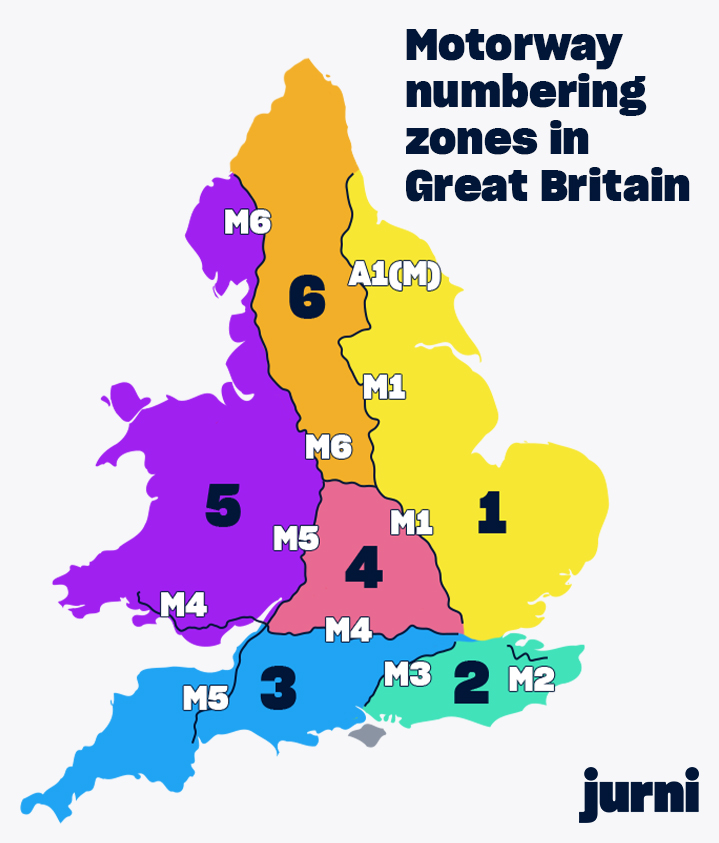
In England and Wales, the first four motorway routes are:
- M1 – London to Leeds
- M2 – London to Kent
- M3 – London to Southampton
- M4 – London to Pont Abraham
The final two routes are arranged differently from the A-road zones so that Zone 4 is split into a smaller area:
- M5 – Birmingham to Exeter
- M6 – Rugby to Gretna
Just like A-roads, a motorway’s number usually reflects the zone where it begins, and if it crosses several zones, the furthest anticlockwise zone decides the number. That’s why the M25 (London’s orbital) carries a “2” even though it passes through Zones 1, 3, and 4.
The system isn’t perfect, and the zones can get a little messy. The M48 and M49 near Bristol, for example, break the rules entirely because they were added later to improve network links and don’t follow the zone numbering at all. Similarly, the M69 between Coventry and Leicester follows the line of the A46 but lies wholly in Zone 6, so it couldn’t be called the M46.
Many three-digit motorways also bend the rules. Short spurs like the M271 near Southampton take their numbers from the larger routes they branch off, rather than from the zones themselves.
Scotland: a simpler approach
Scotland uses a much clearer system. Here, motorway numbers simply follow the A-roads they replace:
- The M8 follows the A8
- The M9 follows the A9
- The M80 follows the A80
This explains why there’s no M7 motorway because the A7 has never been upgraded to motorway status, so an M7 doesn’t exist.
There are a few exceptions, such as the M73, which doesn’t exactly shadow the A73 but still borrows its number.
Northern Ireland: the tree and branch system
In Northern Ireland, motorway numbering centres on Belfast. The M1 and M2 radiate outward, and spurs or branches take related numbers, like the M12 and M22.
Not all of the planned network was built, but the “tree and branch” idea is still clear in the numbering today.
What about A(M) roads?
One unique quirk of the UK road naming system is the A(M) designation. These are stretches of A-roads upgraded to motorway standard but stay linked to their original A-road number.
Examples include:
- A1(M) – motorway sections of the A1, such as the stretch between Stevenage and Peterborough.
- A74(M) – part of the Glasgow–Carlisle route, sitting alongside the M74
- A48(M) – a short motorway spur near Cardiff
These roads are fully fledged motorways in terms of restrictions and standards, but their unusual naming often confuses drivers. For instance, many people assume the A1(M) is a spur of the M1 – when in fact it isn’t.
Conclusion
The UK's road numbering system is part history, part logic, and part compromise:
- A-roads and B-roads follow a zonal system first set up in the 1920s, with shorter numbers originally reserved for the most important routes
- Motorways, introduced in the late 1950s, brought a new "M" prefix and their own set of rules
- In England and Wales, motorway numbers borrow from the A-road zones but apply new conventions
- In Scotland, motorways mirror the A-roads they replace, which is why there’s no M7
- In Northern Ireland, a tree-and-branch model was adopted around Belfast
So next time you’re driving along the A38 or heading north on the M61, you’ll know the hidden system behind the road numbers.
Thinking about your next car?
At Jurni, we make the leasing process simple and stress-free. Whether you’re planning motorway miles on the M1, or sticking to your local A-roads, we’ve got great deals to suit every journey. From practical city cars to spacious SUVs, we work with trusted manufacturers like Toyota, Kia, Audi, BMW, and more. With plenty of choice and expert support, finding your next car has never been easier.





.png)