

.jpg)

In this guide:
- How does electric car charging work?
- Types of chargers
- Charging at home
- Charging at work
- Finding a charger on the go
- Installing an electric vehicle charging point
- How much does it cost to charge an EV?
- How long does charging take?
How does electric car charging work?
Charging an electric or plug-in hybrid vehicle works similarly to charging any electric device — just on a larger scale. An electric power source – either from a home charger, a unit at a workplace, or a public station – is delivered to your vehicle through a cable, where a connection is established to safely charge the battery. There’s a lot of expertly engineered technology behind the process, but all you need to do is simply plug a connector cable at a charging point into your car’s port, confirm the charge, and wait to power up.
Why charge to 80% instead of 100%
It’s generally recommended that electric vehicles are charged up to 80% rather than 100%. While charging up to a full charge isn’t damaging, and might be necessary on occasion to give you the range needed for your journey, there are several benefits to aiming for an 80% charge:
- Prolongs the life of your battery, which will eventually deteriorate over time.
- Batteries perform more efficiently on a 20-80% charge, with some people finding the first 20% of a full charge depletes much quicker.
- Charging slows down significantly once you get over 80% to protect the battery.
- Less time spent waiting for the vehicle to charge fully.
Types of EV chargers
The main things to know about EV chargers are the speed, power type, and connector types.
There are three types of charging speeds available, dubbed Slow, Fast and Rapid. These chargers will use AC (Alternating Current) or DC (Direct Current) power to charge the battery in an electric car, with AC units providing slower charging speeds than DC units. You’ll also come across a range of connector types, a bit like different types of plugs. The most common connectors in the UK are CCS, Type 2, and CHAdeMO.
Another thing to keep in mind is that some chargers will be tethered. This means that you don’t need to bring a cable to the charging point because there will already be one attached. On the flip side, some public AC charging points are untethered, meaning they won't have a cable attached, and you'll need to bring your own in order to use it.
|
Speed |
Power types |
Charger power (kW) |
Connector types |
|
Slow chargers |
AC |
3-6kW |
3-pin, Type 1, Type 2, Commando |
|
Fast chargers |
AC |
7-22kW |
Type 1, Type 2, Commando |
|
Rapid chargers |
DC |
50-120kW |
Type 2, CCS, CHAdeMo, Tesla Type 2 |
Slow chargers
Slow charging typically performs between 3kW to 6kW and uses AC power. You can expect this level of charging from a home charger or when using a 3-pin plug.
With a 3kW unit, you can expect a full charge to take between 6-12 hours, although this will vary depending on the vehicle. The majority of public slow charging points will be untethered and will use a Type 2 connector.
Fast chargers
Fast charging delivers between 7kW to 22kW and uses AC power. These types of chargers are common at supermarkets and car parks, and can also be installed at your home.
Depending on the vehicle, with a 7kW unit, a full recharge could take between 4-6 hours, while a 22kW charger can take around 1-2 hours. Most fast charging points will be untethered, although some home and work units may have charging cables attached. You’ll generally find that fast chargers use a Type 2 connector.
Rapid chargers
As the name suggests, rapid charging is a broad term for the fastest chargers available. Rapid chargers will typically use two DC connectors, but there are also rapid AC chargers that use Type 2 connectors at 43kW. Ultra-rapid DC chargers provide power upwards of 100kW, making them particularly convenient for a superfast top-up.
Depending on the model, most electric vehicles can be charged to the optimum level of 80% in under an hour with rapid charging. Ultra rapid DC charging stations can power up the latest long-range EV models in as little as 20 minutes.
AC power and DC power
Electric vehicles can only store DC power to charge the batteries. When you charge with an alternating current (AC) power unit, your vehicle uses an onboard conversion process to convert the AC power into DC power to charge and store energy for later use. Whereas, when you use a direct current (DC) power unit, the power can bypass the converter and head straight to the battery, which is why rapid chargers using DC power provide a much faster charge.
All rapid charging points are tethered and are usually found at motorway service stations and along main routes where you’ll need the most amount of power to get you back on the road in the shortest amount of time.
Different connector types
CCS, CHAdeMO, and Type 2 are the three main connectors that you are likely to come across.
- CSS - a standard EV connector that delivers rapid or ultra-rapid charging with DC power. This charger looks like a Type 2 on top, with two extra pins on a bar below this.
- CHAdeMO - seen on some Japanese-manufactured EVs, and provides rapid or ultra-rapid charging with DC power.
- Type 2 - a very common charger that offers a range of speeds through AC power.
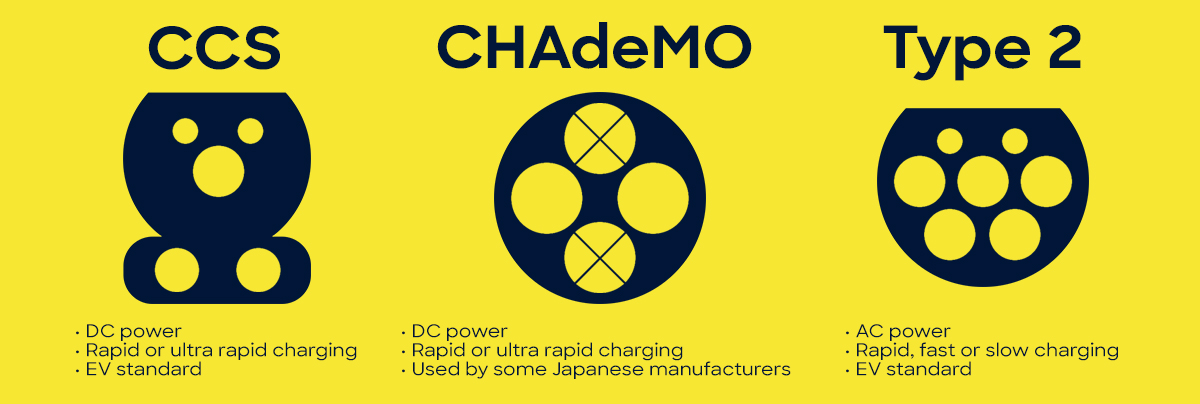
Your vehicle handbook will tell you what charger type you need. Otherwise, you can just open the charging port and take a look at the pin pattern, as they are quite distinctive. It would be impossible for you to accidentally put the wrong connector in your vehicle, as it simply wouldn’t fit.
Charging at home
Technically, you can charge your electric or plug-in hybrid vehicle (PHEV) at home by using a standard 3-pin plug; however, this can be slow and cumbersome. It’s also not a long-term solution as these sockets aren’t designed to draw the amount of power required. Installing a home charging point will give you access to quicker and safer charging.
Home charging points are normally fitted in the garage or on an outside wall near the driveway, where you’ll have exclusive access to charging whenever you need it. Although home charging is much slower, you can pop your car on charge overnight while you sleep and wake up to a full charge.
Charging at work
Charging points at a place of work are as handy as home charging points. They allow employees to charge their vehicle during the course of the working day, ready to drive home on a topped-up battery.
However, as more people are discovering the benefits of electric vehicles and making the switch, an increasing number of charging points will be needed, often requiring intensive installation work. The work may also cost extra if charge points are installed in car park spaces at a greater distance from the building.
When looking at workplace charging solutions, installers will carry out a site visit to fully establish the best options for the business.
Finding a charger on-the-go
Many EV drivers struggle with range anxiety, worrying about running out of charge while on the road, particularly for longer journeys. However, the charging network across the UK consists of over 73,000 charge points, and this is increasing all the time, so you’ll never be far from a top-up.
Searching for suitable charge points near you when on the go is easy, with several apps available to locate charging points on your route, such as Zap-Map and PlugShare. Or you can even use Google Maps to quickly find chargers in your area.
Installing an electric vehicle charging point
Costs of installation
The overall cost for a home charge point is around £1,000, while workplace charge points are between £1,000 and £1,500. However, the Office for Zero Emission Vehicles offers several grants to offset some of this cost, which could save you up to £350 per charger!
- Home EV chargepoint grant for renters and flat owners
- Home EV chargepoint grant for households with on-street parking
- Commercial EV infrastructure grant for staff and fleets
- Workplace Charging Scheme
Suppliers for EV charging points
There are several well-established suppliers operating across the UK to connect homes and workplaces to the EV charging infrastructure, such as Ohme and E.ON Energy.
If you want to use a grant to help with the installation costs, make sure your supplier is on the OZEV’s approved list to benefit from this saving.
How much does it cost to charge an EV?
The exact costs of charging an EV will depend on your specific vehicle and the size of its battery, the speed of the charger you use, and where it is. Home charging is undeniably the cheapest way to charge an EV, particularly if you charge overnight. Public charging is more expensive, and prices increase with speed.
For example, let's say you’re charging a Volvo EX90 Estate, which is quite a large EV. To power this car from 0% to 80% with a home charger overnight at a rate of 7kW and off-peak costs of 7p/kWh, this would cost just £6.12. In contrast, to get to 80% using an ultra-rapid charger at a rate of 150kW costing 76p/kWh, this would cost £67.56. Though this is significantly more expensive, it’s still cheaper than petrol and diesel!
Businesses can offer employees fuel cards to access the largest EV networks with ease, such as Shell and bp pulse, and make managing charging expenses just as straightforward as traditional fuel types.
How long does charging take?
The time to charge an EV will vary depending on the same factors that affect cost: the vehicle, charging speed, and whether you charge at home or at a public station.
If we take a look at the Volvo EX90 Estate again, charging to 80% would take 12.7 hours with a home charger. This sounds like a long time on the surface, but you could simply plug in your charger when you get home and then leave it until the morning. An ultra-rapid charger would take just 1.5 hours to achieve the same charge, which is more than enough time to run a few errands, do a bit of shopping, or get something to eat in the meantime.
If you're travelling a long distance with your EV, rapid and ultra-rapid chargers at service stations are readily available, so by the time you’ve had a rest and replenished your energy, you won’t need to sit around for too long.
Use our free charge time and cost calculator to estimate what charging might look like for your electric vehicle.
Power up with electric vehicles
Leasing an EV or hybrid is a great way to experience the lower running costs, latest tech, and improved performance of electric driving on a flexible contract that’s easy to manage, without any hassle.
Explore our unmissable electric and hybrid vehicle lease deals and start your electric journey today.



.png)