

.jpg)

Ever looked at the side of your tyre and wondered what all those numbers and letters mean? You're not alone! In this article, we'll explain how to read common tyre markings like size, maximum load and speed rating.
Let's break down an example: 205/55 R16 91 V
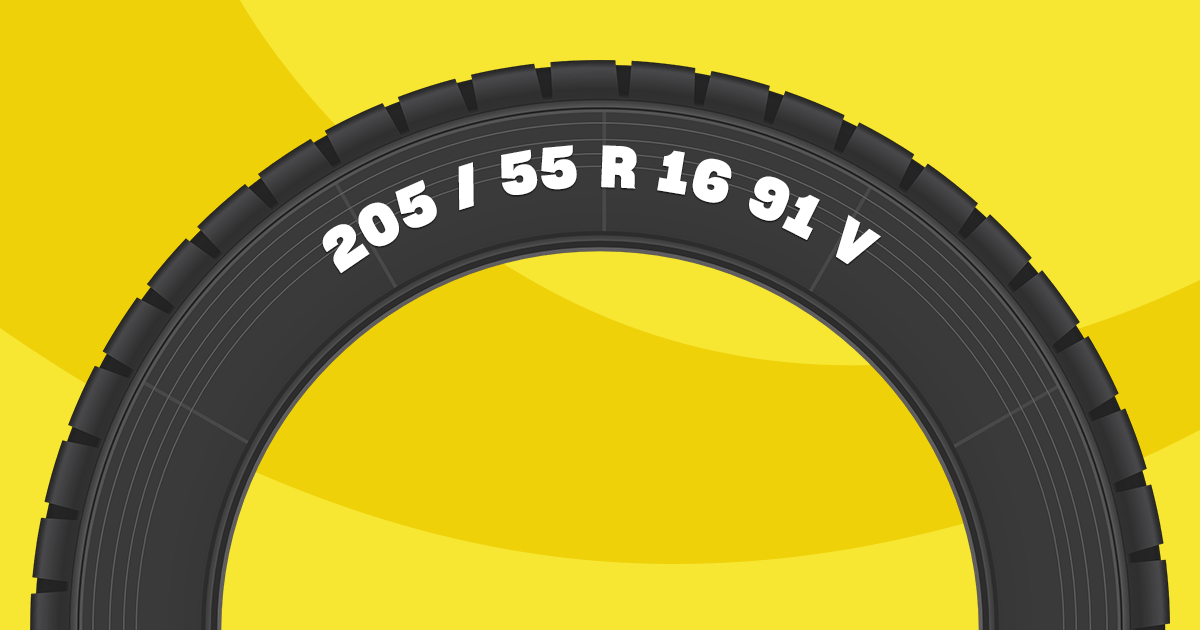
Tyre width: 205
The first number, in this case 205, represents the tyre width in millimetres. This is the distance from one sidewall to the other. A wider tyre will give you more grip and stability, while a narrower one can help improve fuel efficiency.
Tyre aspect ratio: 55
The next number represents the tyre's aspect ratio. This figure shows the height of the tyre's sidewall as a percentage of its width. In our example, the sidewall height is 55% of the tyre's width of 205mm.
This number is important because a lower aspect ratio means a shorter, sportier sidewall, which can improve handling but may lead to a firmer ride. On the other hand, a higher aspect ratio means a taller sidewall, offering a more comfortable ride but potentially less responsiveness during spirited driving.
Tyre construction: R
The R stands for Radial construction, the most common type of tyre construction today. R indicates that the tyre has layers of fabric with cords that run radially across the tyre, providing strength and flexibility. This makes for better handling, improved fuel economy and a smoother ride.
There are other tyre types of tyre construction, like D for diagonal or B for bias belt, but they’re mostly used on specific vehicles like motorcycles or heavy-duty trucks.
Tyre diameter: 16
The following number represents the diameter of the wheel that the tyre is made to fit, measured in inches. This measurement is crucial when selecting a tyre, as it must match the size of your vehicle's wheel.
Tyre maximum load: 91
The last number is the load index rating which tells you how much weight the tyre can support when properly inflated.
In this example, 91 translates to 615kg per tyre. If your car is particularly heavy or you regularly carry heavy loads, use the load index to ensure your tyres are suitable for the job.
| Load index | kg | Load index | kg |
| 69 | 325 | 89 | 580 |
| 70 | 335 | 90 | 600 |
| 71 | 345 | 91 | 615 |
| 72 | 355 | 92 | 630 |
| 73 | 365 | 93 | 650 |
| 74 | 375 | 94 | 670 |
| 75 | 387 | 95 | 690 |
| 76 | 400 | 96 | 710 |
| 77 | 412 | 97 | 730 |
| 78 | 425 | 98 | 750 |
| 79 | 437 | 99 | 775 |
| 80 | 450 | 100 | 800 |
| 81 | 462 | 101 | 825 |
| 82 | 475 | 102 | 850 |
| 83 | 487 | 103 | 875 |
| 84 | 500 | 104 | 900 |
| 85 | 515 | 105 | 925 |
| 86 | 530 | 106 | 950 |
| 87 | 545 | 107 | 975 |
| 88 | 560 | 108 | 1000 |
Tyre speed rating: V
The final part of the code is the speed rating. This letter indicates the maximum speed the tyre can safely handle.
In our example, V means the tyre can reach speeds up to 149mph. A tyre with a lower speed rating may be sufficient for most everyday driving.
| Speed rating | mph | Speed rating | mph |
| K | 68 | S | 112 |
| L | 75 | T | 118 |
| M | 81 | U | 124 |
| N | 87 | H | 130 |
| P | 93 | V | 149 |
| Q | 100 | W | 168 |
| R | 106 | Y | 186 |
More tyre markings explained
You might also find the following codes on your tyre:
DOT stands for the Department of Transportation, and the following numbers indicate where and when the tyre was manufactured. If the final four numbers read 3924, the tyre was made in the 39th week of 2024.
REF stands for reinforced tyres. These tyres are designed to handle extra weight and may also be shown as XL, EXL, RF, REINF or RFD, depending on the manufacturer.
RFT stands for run-flat tyres. These tyres are designed to last without pressure for a short period, giving you time to drive to a safe place after a puncture.
M+S stands for Mud and Snow, meaning the tyre is suitable for winter conditions.
TWI stands for Tread Wear Indicator and is a marking that helps you know when your tyre needs replacing.
HL stands for heavy load and is found on electric vehicle (EV) tyres because they can handle a higher load index.


.png)